The Algorithm Inside a Dive Computer
I fell in love with SCUBA diving on my first dive in the Red Sea, at 16 years old. The colourful corals and fish made the underwater world feel like an alien planet, and a close encounter with a moray eel gave me enough of a thrill to cement that dive as one of my core memories. In this article, we’ll explore decompression theory by building a simplified Bühlmann model in Rust. By the end, you should have a better understanding of the science and maths that help divers manage decompression risk while exploring the underwater world.
This article is for educational purposes only. It is not a guide for building or modifying your own decompression algorithm and using it to dive. Dive computers are life-support equipment. Their algorithms require expert development and rigorous validation. Never dive on unverified or self-made decompression software.
The Decompression Problem
Before we explore how the algorithm works, we need a rough grasp of decompression theory. Divers breathe gas to stay alive, usually air, the same as we breathe on the surface1. Physics and anatomy force them to breathe it at higher pressure than we do on land, and the deeper they go, the higher that pressure climbs.
Pressure in this article is measured in bar2, appologies to my AMER readers who are accustomed to psi. One bar is roughly the weight of the atmosphere pressing down on you at sea level. Descend 10 metres into the ocean and the water above you adds another bar, so a diver at 30 metres is breathing gas at about 4 bar, four times the pressure at the surface.
Right now, sitting on the surface, your body is already full of nitrogen. Air is about 78% nitrogen, and Henry’s Law3 says the amount of a gas that dissolves into a liquid is proportional to the partial pressure4 of that gas. At 1 bar of air, your blood and tissues sit at equilibrium with roughly 0.76 bar of dissolved nitrogen, provided you have been breathing that air long enough to equilibrate.
Descending changes the pressure, and therefore the equilibrium. A diver at 30 metres inhales nitrogen at about 3.1 bar instead of 0.76, so it diffuses out of the lungs, into the blood, and into the tissues until they catch up. This is on-gassing, and on its own it still isn’t a problem. We’ll pretend nitrogen is “inert”, meaning the body doesn’t metabolise it, and we’ll conveniently ignore nitrogen narcosis5.

The trouble starts on the way back up. Think of a carbonated drink, bottled under high pressure so large amounts of CO₂ dissolve into the liquid. Pop the cap, the pressure drops, the equilibrium breaks, and the gas escapes as bubbles. In a diver’s body, nitrogen normally leaves the tissues dissolved in blood and diffuses into the lungs to be exhaled. Bubbles can also form, sometimes without symptoms, but they can cause decompression sickness6. In very simple terms, decompression sickness is a lot like when you shake a coke bottle and open it, most of the liquid as well as a ton of bubbles will escape and you’ll have a mess. This is of course a very simplified representation, and in most cases it’s not as dramatic as described, but an excessive amount of bubbles and their location can lead to lethal outcomes in certain cases.
Now shake that bottle and open it slowly. Crack the cap, let some pressure out, wait, crack it further. Releasing the pressure gradually helps keep the drink in the bottle. The analogy illustrates why the rate of pressure reduction matters. A controlled ascent gives dissolved nitrogen time to leave the body through the lungs, and decompression algorithms help schedule that ascent.
A decompression algorithm answers one question:
Given everything I have breathed so far, how shallow does the algorithm permit me to be right now, and how long must I wait before I can go shallower?
Simplified Algorithm
We’ll implement arguably the most popular decompression algorithm, the Bühlmann ZH-L167 with Gradient Factors. But we’ll do it in piecemeal fashion, starting with a simpler version, not the fully featured one present in dive software. The Bühlmann ZH-L16 is commonly used in dive computers and for building dive tables8 meant for recreational9 and technical10 SCUBA divers, while commercial11 and military divers normally use different algorithms1213 custom designed for their needs. Besides ZH-L16, recreational and technical dive computers also use VPM-B14 or RGBM15 models, but the focus here will be ZH-L16 as it seems to be most widely used.
We’ll start with a simplified version of the algorithm to master the basic concepts. We’ll model a single dive in seawater, starting at sea level and breathing air throughout. Repetitive dives, altitude, multiple breathing mixtures, and water density introduce additional considerations for tissue loading or the conversion between depth and pressure. We’ll also skip gradient factors16 for now.
Modelling the Human Body
A dive computer does not measure dissolved nitrogen in the diver’s tissues. Instead it measures environmental pressure and elapsed time, combines them with the selected breathing gas, and mathematically models what’s happening in your body based on those inputs. These models are generic; they aren’t customised for each person and their body composition. They were built through decades of experiments, starting with John Scott Haldane17, alongside Arthur Boycott and Guybon Damant18, who in 1908 proposed the first such model.
They treated the body as a set of theoretical compartments, five in total, each a sponge soaking up and releasing gas with its own half-time. Bühlmann ZH-L167 uses sixteen, numbered fastest to slowest. In the ZH-L16C table we’ll use19, compartment 1’s half-time is 5 minutes, representing rapid gas exchange in well-perfused tissue; compartment 16’s is 635 minutes, over 10 hours, representing slower gas exchange in poorly perfused tissue. None correspond to a specific organ. They’re a mathematical convenience covering the range of speeds real tissue might load and unload nitrogen at, and the 16 in ZH-L16 refers to them.
A half-time is how long a compartment takes to close half the gap between its current nitrogen tension and where it’s heading. Drop a diver to a new depth and every compartment starts chasing the new inspired pressure, none of them jumping straight to it: after one half-time each has closed 50% of the gap, after two 75%, after three 87.5%, the same halving pattern as radioactive decay. A compartment never fully saturates in the mathematics, but after about six half-times it’s close enough to treat as done. Compartment 1 is effectively saturated within 30 minutes; compartment 16 needs over 60 hours.
Each compartment updates independently using the same exponential formula, known as Haldane’s equation:
is the compartment’s nitrogen tension after time , is what it started at, and is the alveolar pressure of nitrogen the diver is currently breathing, essentially the partial pressure of nitrogen at the current depth. is the compartment’s defining property. Because every compartment runs this formula on its own clock, a single dive profile produces 16 different loading curves, and the algorithm tracks all of them at once.
30 m on air for 30 minutes, then 120 minutes at the surface
Nitrogen tension (bar)
Elapsed time (minutes)
- #1 · 5 min
- #5 · 27 min
- #9 · 109 min
- #16 · 635 min
- Inspired N₂
Four of the sixteen compartments over a 30 metre dive on air, 30 minutes long, followed by two hours at the surface. Compartment 1 is close to saturation by the end of the bottom interval and releases much of its excess nitrogen in the first 30 minutes after surfacing. Compartment 16 barely notices the dive at all, and is still holding much of the little excess nitrogen it picked up two hours later.
Let’s start turning this into code. A compartment only needs to remember two numbers, its half-time and its current tension, and it only needs to know how to do one thing, update itself given the pressure the diver is currently breathing and how long they’ve been breathing it:
#[derive(Debug, Clone, Copy)]
struct Compartment {
    half_time: f64, // minutes
    tension: f64,   // current N2 tension, in bar
}

impl Compartment {
    fn constant_depth(&mut self, p_alv: f64, duration: f64) {
        let decay = 2f64.powf(-duration / self.half_time);
        self.tension = p_alv + (self.tension - p_alv) * decay;
    }
}
Like Haldane’s equation, the code assumes that inspired pressure remains constant throughout the interval. To approximate a changing depth, we can divide the profile into short discrete intervals and update the compartment tensions using a constant pressure for each one. Sampling and update frequencies depend on the implementation; one-second intervals are an example we’ll use here.
We’ll model 16 tissue compartments using the nitrogen half-times from the ZH-L16C table in Subsurface19. As a fun tangent, one of the original contributors to Subsurface, a desktop dive planning and logging software, is the myth, the legend, Linus Torvalds20 himself, and he still occasionally contributes changes.
const COMPARTMENTS: usize = 16;

// in minutes
const HALF_TIMES: [f64; COMPARTMENTS] = [
    5.0, 8.0, 12.5, 18.5, 27.0, 38.3, 54.3, 77.0, 109.0, 146.0, 187.0, 239.0, 305.0, 390.0,
    498.0, 635.0,
];
A diver who’s been breathing surface air for long enough starts every dive with all 16 compartments already at equilibrium, so we can build the whole tissue model from that single starting tension:
fn equilibrated(surface_n2: f64) -> [Compartment; COMPARTMENTS] {
    HALF_TIMES.map(|half_time| Compartment {
        half_time,
        tension: surface_n2,
    })
}
M Values
Tracking nitrogen loading is only half the problem. To answer the question posed at the beginning of the article, we need to compare each compartment’s tension against a limit. An M-value21 is the maximum inert gas tension that the model permits in a compartment at a given ambient pressure. In our air-only model, we track nitrogen. Exceeding an M-value doesn’t mean a diver will automatically develop decompression sickness, and staying below it doesn’t guarantee they won’t. It is a model limit, not a precise boundary between safe and unsafe exposures.
Robert Workman introduced them at the US Navy in 196522, replacing Haldane’s fixed 2:1 ratio with the observation that each compartment tolerates a different absolute overpressure, and that the tolerance changes with depth. Bühlmann used Workman’s M-value equation, but he modified it to use ambient pressure instead of depth, which made it portable to altitude diving23:
is the ambient pressure at the diver’s current depth, and is the maximum nitrogen tension that compartment is allowed to hold at that pressure. Each of the 16 compartments has its own and . Fast compartments have M-value lines that tolerate a large overpressure, while slow compartments have lower tolerated gradients.
Comparing tissue tensions against their M-values gives us the ceiling depth, the shallowest depth at which no compartment would exceed its M-value. The compartment requiring the deepest ceiling is the controlling compartment. The model does not permit ascent above that ceiling, but the ceiling itself changes as the compartments load and unload gas during ascent.
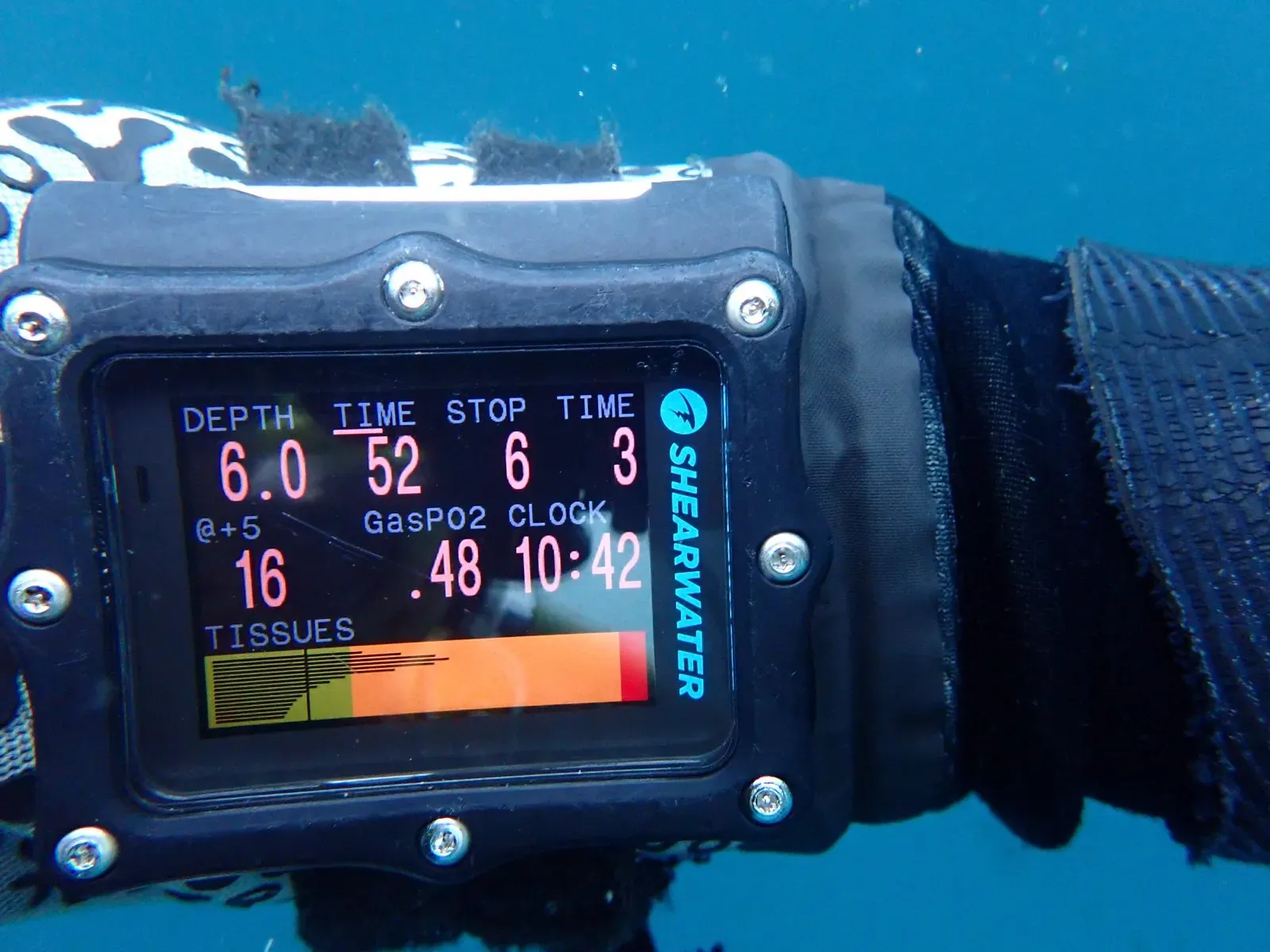
The bar graph at the bottom of this dive computer is a great represenataion of the tissue model: horizontal bars stacked vertically show the estimated inert gas tension of each compartment, while the red boundary marks the compartments’ M-values. Photo by Peter Southwood, CC BY-SA 4.0, via Wikimedia Commons.

Back in the code, each Compartment picks up its a and b coefficients, plus a way to evaluate its own M-value at a given ambient pressure and, by rearranging that same equation, the ambient pressure at which its current tension would sit exactly on the M-value:
#[derive(Debug, Clone, Copy)]
struct Compartment {
    half_time: f64, // minutes
    tension: f64,   // current N2 tension, in bar
    a: f64,         // M-value coefficient
    b: f64,         // M-value coefficient
}

impl Compartment {
    fn constant_depth(&mut self, p_alv: f64, duration: f64) {
        let decay = 2f64.powf(-duration / self.half_time);
        self.tension = p_alv + (self.tension - p_alv) * decay;
    }

    fn m_value(&self, ambient: f64) -> f64 {
        self.a + ambient / self.b
    }

    fn ceiling_pressure(&self) -> f64 {
        (self.tension - self.a) * self.b
    }
}
ceiling_pressure is the M-value formula solved for ambient instead of M: at what ambient pressure would this compartment’s tension sit exactly on its M-value? That’s the compartment’s own ceiling. Bühlmann published a and b alongside the half-times, so we can copy his homework:
const COMPARTMENTS: usize = 16;

struct GasTable {
    half_times: [f64; COMPARTMENTS],
    a: [f64; COMPARTMENTS],
    b: [f64; COMPARTMENTS],
}

static ZH_L16C_N2: GasTable = GasTable {
    half_times: [
        5.0, 8.0, 12.5, 18.5, 27.0, 38.3, 54.3, 77.0, 109.0, 146.0, 187.0, 239.0, 305.0, 390.0,
        498.0, 635.0,
    ],
    a: [
        1.1696, 1.0000, 0.8618, 0.7562, 0.6200, 0.5043, 0.4410, 0.4000, 0.3750, 0.3500, 0.3295,
        0.3065, 0.2835, 0.2610, 0.2480, 0.2327,
    ],
    b: [
        0.5578, 0.6514, 0.7222, 0.7825, 0.8126, 0.8434, 0.8693, 0.8910, 0.9092, 0.9222, 0.9319,
        0.9403, 0.9477, 0.9544, 0.9602, 0.9653,
    ],
};
The HALF_TIMES array from the previous section has been absorbed into ZH_L16C_N2.half_times. We’ve expanded the model to include a and b arrays from Subsurface’s published C++ implementation19. These coefficients are for nitrogen; helium, another common gas divers breathe, has its own coefficients and half-times. Bühlmann produced three sets of a/b coefficients for nitrogen: A, B, and C. The choice of dataset affects how conservative the resulting model is.
ZH-L16A7 is the original, purely mathematical dataset, where Bühlmann derived and directly from each compartment’s half-time. ZH-L16B tightens the coefficient for some compartments, while leaving the rest of the table equal to A7. Bühlmann recommended B for table calculation and C for dive computers21. Rounding a table toward greater depth and longer time can add conservatism; rounding in the opposite direction can remove it.
The Loop
With Haldane’s equation to track nitrogen loading and M-values to define a model ceiling, the algorithm itself is mostly a loop. At each discrete time step, for example once per second, it does the same three things:
- Read absolute ambient pressure from the pressure sensor, or convert a planned depth into pressure, then calculate inspired nitrogen pressure.
- Update all 16 compartments using Haldane’s equation, based on how long the diver has been at that depth.
- Find the controlling compartment based on M-value parameters for each compartment and determine the ceiling pressure.
If the ceiling depth is zero, no compartment currently requires the diver to remain below the surface under this model. A positive ceiling sets a depth the diver must not ascend above while it remains in effect. It does not necessarily imply a future stop at that exact depth: gas exchange during ascent to the ceiling depth may lift the ceiling before the diver reaches it.
Many dive computers also display a recommended safety stop, commonly three minutes at five metres, even when no decompression stop is required. This provides an additional margin for satefy. The model estimates tissue loading but cannot capture every physiological factor affecting decompression risk16. A safety stop is distinct from a required decompression stop, which is needed when continued ascent would violate the model’s limits.
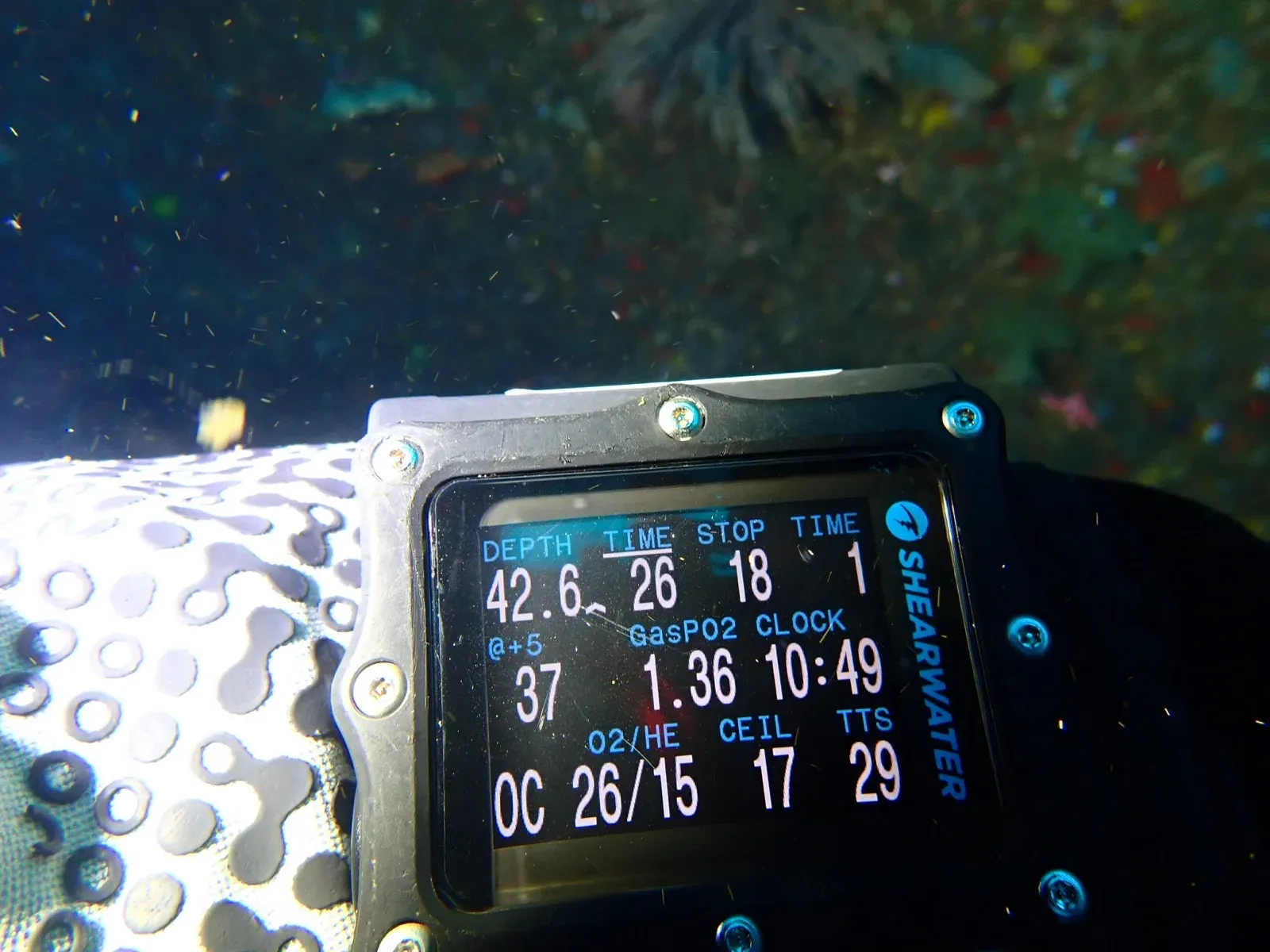
Dive computer in action. This diver is at 42.6 m with 26 minutes of elapsed dive time on a gas mixture called 26/15 trimix. CEIL 17 is the ceiling depth, STOP 18 is the next predicted decompression stop, and TTS 29 is the predicted total time to surface, including decompression stops, using the computer’s assumed ascent rate and gas switches. Photo by Peter Southwood, CC BY-SA 4.0, via Wikimedia Commons.

Expanding the code, we can define a DecoModel to house all the logic. DecoModel::new builds the tissue model the way equilibrated did, now also seeding each compartment’s a and b:
const SURFACE_PRESSURE: f64 = 1.01325; // bar, the standard atmosphere
const WATER_VAPOUR: f64 = 0.0627; // bar, in the lungs at body temperature
const FRACTION_N2: f64 = 0.79; // breathing air

#[derive(Debug, Clone, Copy)]
struct DecoModel {
    compartments: [Compartment; COMPARTMENTS],
}

impl DecoModel {
    fn new(table: &GasTable) -> Self {
        let surface_n2 = FRACTION_N2 * (SURFACE_PRESSURE - WATER_VAPOUR);
        DecoModel {
            compartments: std::array::from_fn(|i| Compartment {
                half_time: table.half_times[i],
                tension: surface_n2,
                a: table.a[i],
                b: table.b[i],
            }),
        }
    }
}
We need to account for WATER_VAPOUR because inhaled air is humidified in the lungs before nitrogen’s partial pressure is calculated; that fixed 0.0627 bar7 displaces breathing gas and never carries nitrogen. FRACTION_N2 is 0.79 because while air’s true nitrogen content is 78.08%, diving convention lumps argon and the other trace gases in with nitrogen and treats the result as one inert gas. SURFACE_PRESSURE is 1.01325, the standard atmosphere. The M-value equations themselves use absolute ambient pressure and can be evaluated at other surface pressures.
Then we expand DecoModel with record and ceiling, which will be used to implement the three-item loop described above:
impl DecoModel {
    fn record(&mut self, depth_m: f64, duration: f64) {
        let ambient = SURFACE_PRESSURE + depth_m / 10.0;
        let p_alv = FRACTION_N2 * (ambient - WATER_VAPOUR);
        for c in &mut self.compartments {
            c.constant_depth(p_alv, duration);
        }
    }

    fn ceiling(&self) -> f64 {
        let ceiling_pressure = self
            .compartments
            .iter()
            .map(Compartment::ceiling_pressure)
            .fold(SURFACE_PRESSURE, f64::max);
        ((ceiling_pressure - SURFACE_PRESSURE) * 10.0).max(0.0)
    }
}
We’ll run record to update tissue tension for each of the 16 compartments at each time step. The ceiling method takes the highest ceiling pressure across all 16 compartments, since that’s the greatest minimum ambient pressure any compartment requires. It then converts that pressure to a depth, clamped at zero.
Here’s how we can simulate 45 minutes at 30 metres, breathing air:
let mut model = DecoModel::new(&ZH_L16C_N2);

for minute in 1..=45 {
    model.record(30.0, 1.0);
    let ceiling = model.ceiling();
    if ceiling > 0.0 {
        println!("{minute} min: current model ceiling: {ceiling:.1} m");
    }
}
This simulation assumes an instantaneous descent to 30 metres followed by a constant-depth interval. It does not simulate ascent. Real dive profiles24 often include changes in depth throughout the dive. Running the code above, we’d see no positive ceiling for the first 16 minutes. At 17 minutes a ceiling appears, about 14 centimetres deep, and it grows the longer the bottom time stretches: 0.95 m at 20 minutes, 2.9 m at 30, 4.9 m at 45. The printed output rounds these depths to one decimal place.
We can use a mathematical shortcut to compute no-stop time25 for this simplified profile. Many dive computers have a “Plan Dive” feature that estimates how long a diver can remain at a selected depth before decompression stops become necessary. Our calculation is more limited: it assumes a constant depth and breathing mixture, and ignores gas exchange during ascent. We solve Haldane’s equation for the time when a compartment’s tension reaches its surface M-value :
Here, is the compartment’s half-time, is the constant inspired nitrogen pressure, and is the compartment’s initial tension. For a compartment that is loading towards a pressure above its surface M-value, the smallest time across all compartments gives us the no-stop time under these assumptions. If every compartment is already at or below its surface M-value and none can exceed it at the selected depth, the model returns an unlimited no-stop time. If a compartment already exceeds its surface M-value, it returns AlreadyExceeded.
#[derive(Debug, Clone, Copy, PartialEq)]
enum NoStopTime {
    AlreadyExceeded,
    Finite(f64),
    Unlimited,
}

impl DecoModel {
    fn no_stop_time(&self, depth_m: f64) -> NoStopTime {
        let inspired = FRACTION_N2 * (SURFACE_PRESSURE + depth_m / 10.0 - WATER_VAPOUR);
        let mut earliest = f64::INFINITY;
        for c in &self.compartments {
            let limit = c.m_value(SURFACE_PRESSURE);
            if c.tension > limit {
                return NoStopTime::AlreadyExceeded;
            }
            if inspired > limit {
                let time = -c.half_time * ((inspired - limit) / (inspired - c.tension)).log2();
                earliest = earliest.min(time);
            }
        }
        if earliest.is_finite() {
            NoStopTime::Finite(earliest)
        } else {
            NoStopTime::Unlimited
        }
    }
}
At 30 metres on air from surface-equilibrated tissues, this returns 16.54 minutes. At sufficiently shallow depths it returns Unlimited. That unlimited no-stop time only applies to nitrogen loading under the model’s assumptions. Divers must still plan for gas supply and thermal exposure, which this model does not track.
Ascent Rates
The record method can approximate changing pressure through short, constant-pressure intervals. Both dive computers and planning software can use this approach. For a segment with a constant ascent or descent rate and a fixed breathing mixture, we can instead calculate tissue tension directly. Schreiner and Kelley26 published an equation in 1971 that extends Haldane’s equation to give an exact solution for a linearly changing inspired pressure:
is the inspired nitrogen pressure at the start of the segment. is the rate that pressure changes, in bar per minute, and is divided by the half-time. Set to zero and the equation reduces to Haldane’s equation. A slower ascent gives compartments that are off-gassing more time to release nitrogen, although other compartments may still be on-gassing. The chosen ascent and descent rates affect the resulting tissue tensions and any predicted stops; those rates depend on the software settings and the planned dive.
We’ll add changing_depth to Compartment to implement the equation:
impl Compartment {
    fn changing_depth(&mut self, p_alv: f64, rate: f64, duration: f64) {
        let k = std::f64::consts::LN_2 / self.half_time;
        self.tension = p_alv + rate * (duration - 1.0 / k)
            - (p_alv - self.tension - rate / k) * (-k * duration).exp();
    }
}
Compared with constant_depth, this function takes one additional parameter, rate. It is negative during ascent, when inspired pressure falls, and positive during descent. The p_alv argument is the inspired nitrogen pressure at the start of the segment, and duration is in minutes. We now have the compartment update needed for an ascent or descent segment, but we haven’t yet connected it to DecoModel or built an ascent simulation.
Putting It All Together
Let’s give the model a complete dive, from leaving the surface to returning to it. We’ll descend at 20 metres per minute, spend five minutes at 25 metres, then ascend at 10 metres per minute to 10 metres for another 20 minutes. On the way back to the surface, we’ll include a three-minute safety stop at five metres. We want to understand if we’ll remain within the no-stop limits, or if we’ll hit a decompression ceiling. Remember, our model doesn’t have the ability to recommend decompression stops given a ceiling, yet. Unfortunatelly, we can’t use the no_stop_time since that equation isn’t capable of modeling complex multi-level dive profiles.
5 min at 25 m · 20 min at 10 m · 3 min safety stop at 5 m
- Total time
- 31:45
- Descent
- 20 m/min
- Ascent
- 10 m/min
Depth (metres)
Elapsed time (minutes)
- Depth
The full 31 minute 45 second profile. Depth increases downwards; the sloping sections include time spent descending and ascending. The final horizontal section is the three-minute safety stop at five metres.
The interactive display below is our model in action for the described profile. Move the slider below to see all sixteen compartments at that moment. The arrows show whether each compartment is taking up or releasing nitrogen. A compartment can be off-gassing while its tension is still below ambient pressure. If at any point in time any of the compartments would exceed the red limit, that would indicate that we’ve hit a decompression ceiling.
Move through the dive to watch nitrogen load and unload.
- Elapsed time
- 0:00
- Depth
- 0.0 m
- Model ceiling
- 0.00 m
- Inspired N₂
- Ambient
- M-value
↑ On-gassing · ↓ Off-gassing · = Equilibrium
A tissue display inspired by the Shearwater Petrel 3 tissue bar graph, with fast compartments at the top and slow ones at the bottom. This uses our article’s air-only model without gradient factors. Bar scales change with depth and compartment; the numbers show absolute nitrogen tensions in bar.
The full code including the model as well as the main() program which verifies our dive profile:
const COMPARTMENTS: usize = 16;
const SURFACE_PRESSURE: f64 = 1.01325; // bar, the standard atmosphere
const WATER_VAPOUR: f64 = 0.0627; // bar, in the lungs at body temperature
const FRACTION_N2: f64 = 0.79; // breathing air

#[derive(Debug, Clone, Copy)]
struct GasTable {
    half_times: [f64; COMPARTMENTS],
    a: [f64; COMPARTMENTS],
    b: [f64; COMPARTMENTS],
}

static ZH_L16C_N2: GasTable = GasTable {
    half_times: [
        5.0, 8.0, 12.5, 18.5, 27.0, 38.3, 54.3, 77.0, 109.0, 146.0, 187.0, 239.0, 305.0, 390.0,
        498.0, 635.0,
    ],
    a: [
        1.1696, 1.0000, 0.8618, 0.7562, 0.6200, 0.5043, 0.4410, 0.4000, 0.3750, 0.3500, 0.3295,
        0.3065, 0.2835, 0.2610, 0.2480, 0.2327,
    ],
    b: [
        0.5578, 0.6514, 0.7222, 0.7825, 0.8126, 0.8434, 0.8693, 0.8910, 0.9092, 0.9222, 0.9319,
        0.9403, 0.9477, 0.9544, 0.9602, 0.9653,
    ],
};

#[derive(Debug, Clone, Copy)]
struct Compartment {
    half_time: f64, // minutes
    tension: f64,   // current N2 tension, in bar
    a: f64,         // M-value coefficient
    b: f64,         // M-value coefficient
}

impl Compartment {
    fn constant_depth(&mut self, p_alv: f64, duration: f64) {
        let decay = 2f64.powf(-duration / self.half_time);
        self.tension = p_alv + (self.tension - p_alv) * decay;
    }

    fn m_value(&self, ambient: f64) -> f64 {
        self.a + ambient / self.b
    }

    fn ceiling_pressure(&self) -> f64 {
        (self.tension - self.a) * self.b
    }

    fn changing_depth(&mut self, p_alv: f64, rate: f64, duration: f64) {
        let k = std::f64::consts::LN_2 / self.half_time;
        self.tension = p_alv + rate * (duration - 1.0 / k)
            - (p_alv - self.tension - rate / k) * (-k * duration).exp();
    }
}

#[derive(Debug, Clone, Copy, PartialEq)]
enum NoStopTime {
    AlreadyExceeded,
    Finite(f64),
    Unlimited,
}

#[derive(Debug, Clone, Copy)]
struct DecoModel {
    compartments: [Compartment; COMPARTMENTS],
}

impl DecoModel {
    fn new(table: &GasTable) -> Self {
        let surface_n2 = FRACTION_N2 * (SURFACE_PRESSURE - WATER_VAPOUR);
        DecoModel {
            compartments: std::array::from_fn(|i| Compartment {
                half_time: table.half_times[i],
                tension: surface_n2,
                a: table.a[i],
                b: table.b[i],
            }),
        }
    }

    fn record(&mut self, depth_m: f64, duration: f64) {
        let ambient = SURFACE_PRESSURE + depth_m / 10.0;
        let p_alv = FRACTION_N2 * (ambient - WATER_VAPOUR);
        for c in &mut self.compartments {
            c.constant_depth(p_alv, duration);
        }
    }

    fn ceiling(&self) -> f64 {
        let ceiling_pressure = self
            .compartments
            .iter()
            .map(Compartment::ceiling_pressure)
            .fold(SURFACE_PRESSURE, f64::max);
        ((ceiling_pressure - SURFACE_PRESSURE) * 10.0).max(0.0)
    }

    fn record_change(&mut self, start_m: f64, end_m: f64, duration: f64) {
        let p_alv = FRACTION_N2 * (SURFACE_PRESSURE + start_m / 10.0 - WATER_VAPOUR);
        let rate = FRACTION_N2 * (end_m - start_m) / (10.0 * duration);
        for c in &mut self.compartments {
            c.changing_depth(p_alv, rate, duration);
        }
    }

    fn no_stop_time(&self, depth_m: f64) -> NoStopTime {
        let inspired = FRACTION_N2 * (SURFACE_PRESSURE + depth_m / 10.0 - WATER_VAPOUR);
        let mut earliest = f64::INFINITY;
        for c in &self.compartments {
            let limit = c.m_value(SURFACE_PRESSURE);
            if c.tension > limit {
                return NoStopTime::AlreadyExceeded;
            }
            if inspired > limit {
                let time = -c.half_time * ((inspired - limit) / (inspired - c.tension)).log2();
                earliest = earliest.min(time);
            }
        }
        if earliest.is_finite() {
            NoStopTime::Finite(earliest)
        } else {
            NoStopTime::Unlimited
        }
    }
}

fn main() {
    let mut model = DecoModel::new(&ZH_L16C_N2);
    let descent_rate = 20.0; // metres per minute
    let ascent_rate = 10.0;  // metres per minute

    if let NoStopTime::Finite(minutes) = model.no_stop_time(25.0) {
        println!("Initial no-stop time at 25 m: {minutes:.2} min");
    }

    // Descend to 25 m
    model.record_change(0.0, 25.0, 25.0 / descent_rate);
    assert_eq!(model.ceiling(), 0.0, "After descending to 25 m");

    // Stay at 25 m for 5 minutes
    model.record(25.0, 5.0);
    assert_eq!(model.ceiling(), 0.0, "After 5 minutes at 25 m");

    // Ascend to 10 m
    model.record_change(25.0, 10.0, (25.0 - 10.0) / ascent_rate);
    assert_eq!(model.ceiling(), 0.0, "After ascending to 10 m");

    // Stay at 10 m for 20 minutes
    model.record(10.0, 20.0);
    assert_eq!(model.ceiling(), 0.0, "After 20 minutes at 10 m");

    // Ascend to 5 m
    model.record_change(10.0, 5.0, (10.0 - 5.0) / ascent_rate);
    assert_eq!(model.ceiling(), 0.0, "After ascending to 5 m");

    // Safety stop at 5 m for 3 minutes
    model.record(5.0, 3.0);
    assert_eq!(model.ceiling(), 0.0, "After the safety stop");

    // Ascend to the surface
    model.record_change(5.0, 0.0, 5.0 / ascent_rate);
    assert_eq!(model.ceiling(), 0.0, "After surfacing");

    println!("No positive ceiling at any of the seven section boundaries.");
}
Each assertion checks that the ceiling is zero after that section, including the final arrival at the surface. The equations calculate the tissue tensions at each section’s end directly, so we don’t need one-second updates to obtain those values. These assertions only check section boundaries; they do not check for a ceiling that might appear and disappear within a section.
Before starting the profile, no_stop_time(25.0) estimates the constant-depth no-stop time at 25 metres from surface-equilibrated tissues. This calculation ignores travel time and gas exchange during descent and ascent; the subsequent profile calls account for those changes.
Running the program prints:
Initial no-stop time at 25 m: 26.23 min
No positive ceiling at any of the seven section boundaries.
All seven assertions pass. The dive takes 31 minutes 45 seconds, including descent, ascent and the three-minute safety stop. This result applies to the air-only ZH-L16C model above, starting from surface equilibrium without gradient factors. It is an educational model check, not a guarantee against decompression sickness. Based on our model the dive profile tested wouldn’t hit any decompression ceilings at any point.
Where This Leaves Us
The core of the decompression model we’ve implemented is compact. We’re modelling 16 tissue compartments, using Haldane’s equation to calculate tissue tension and M-values to determine compartment limits. We’ve implemented a loop to update those compartments, a no-stop time calculation for a constant-depth profile, and a complete multilevel dive simulation using Schreiner’s equation during descent and ascent.
The example still assumes seawater, sea level, one dive from equilibrated tissues, and one breathing mixture: air. So far, it answers only one part of our original question: what is the shallowest depth permitted by the model right now? We can now follow a planned ascent and check its ceiling, but we haven’t yet implemented stop scheduling to calculate how long the diver must wait before going shallower when a positive ceiling appears.
We’ll continue building the model in a future article, where we’ll try and implement a fully featured model needed for recreational dives.
Footnotes
-
Wikipedia. Atmosphere of Earth https://en.wikipedia.org/wiki/Atmosphere_of_Earth ↩
-
Wikipedia. Bar (unit) https://en.wikipedia.org/wiki/Bar_(unit) ↩
-
Wikipedia. Henry’s law https://en.wikipedia.org/wiki/Henry’s_law ↩ ↩2
-
Wikipedia. Partial pressure https://en.wikipedia.org/wiki/Partial_pressure ↩
-
Wikipedia. Nitrogen narcosis https://en.wikipedia.org/wiki/Nitrogen_narcosis ↩
-
Wikipedia. Decompression sickness https://en.wikipedia.org/wiki/Decompression_sickness ↩
-
Wikipedia. Bühlmann decompression algorithm https://en.wikipedia.org/wiki/Bühlmann_decompression_algorithm ↩ ↩2 ↩3 ↩4 ↩5
-
Wikipedia. Decompression tables https://en.wikipedia.org/wiki/Decompression_tables ↩
-
Wikipedia. Recreational diving https://en.wikipedia.org/wiki/Recreational_diving ↩
-
Wikipedia. Technical diving https://en.wikipedia.org/wiki/Technical_diving ↩
-
Wikipedia. Commercial diving https://en.wikipedia.org/wiki/Commercial_diving ↩
-
Wikipedia. Thalmann algorithm https://en.wikipedia.org/wiki/Thalmann_algorithm ↩
-
Defence R&D Canada. (March, 1992). DCIEM diving manual : air decompression procedures and tables https://publications.gc.ca/site/eng/9.947649/publication.html ↩
-
Wikipedia. Varying Permeability Model https://en.wikipedia.org/wiki/Varying_Permeability_Model ↩
-
Wikipedia. Reduced gradient bubble model https://en.wikipedia.org/wiki/Reduced_gradient_bubble_model ↩
-
Divers Alert Network. (November 1, 2015) Gradient Factors https://dan.org/alert-diver/article/gradient-factors/ ↩ ↩2
-
Wikipedia. John Scott Haldane https://en.wikipedia.org/wiki/John_Scott_Haldane ↩
-
Boycott, A. E., Damant, G. C. C., Haldane, J. S. (1908). The Prevention of Compressed-air Illness, Journal of Hygiene 8(3): 342–443 https://pmc.ncbi.nlm.nih.gov/articles/PMC2167126/ ↩
-
Subsurface, an open source dive log and planner. Bühlmann implementation in
core/deco.cpp, depth and gas switch handling incore/dive.cppcore/deco.cpp ↩ ↩2 ↩3 -
Wikipedia. Linus Torvalds https://en.wikipedia.org/wiki/Linus_Torvalds ↩
-
Baker, E. C. Understanding M-values, especially pp. 2 and 6. PDF ↩ ↩2
-
Workman, R. D. (May 26, 1965). Calculation of Decompression Schedules for Nitrogen-Oxygen and Helium-Oxygen Dives, US Navy Experimental Diving Unit Research Report 6-65 (AD0620879) https://archive.org/details/DTIC_AD0620879 ↩
-
Chapman, P. (1999). An Explanation of Professor A.A. Buehlmann’s ZH-L16 Algorithm https://thetechnicaldiver.com/wp-content/uploads/Explanation-of-Buhlmanns-ZHL-16-algorithm.pdf ↩
-
Wikipedia. Dive Profile https://en.wikipedia.org/wiki/Dive_profile ↩
-
Schreiner, H. R., Kelley, P. L. (1971). A Pragmatic View of Decompression, in Proceedings of the Fourth Symposium on Underwater Physiology. The ramp equation and its derivation are reproduced in Baker, E. C., Introductory Deco Lessons, pp. 4–9. Manufacturer-hosted PDF ↩